Customer Problem:
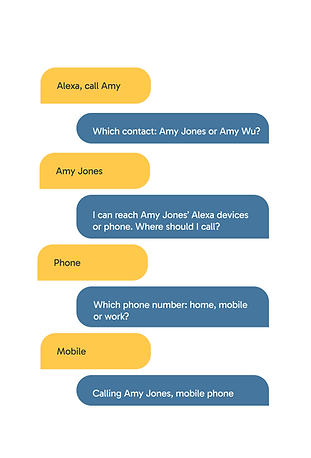
As discussed in the Multimodal Disambiguation case study, Alexa Calling had one of the most complex flows (see simplified version of interaction flow and sample dialog below) and potentially a large number of dialog turns before the customer could place a call. Customers in usability testing and live data showed audible frustration in having to go through these steps every time, even for contacts they reached out to frequently.

Process & Solution(s):
Reviewing the data, I created a tiered logic that would apply to callers who reached out to the same contacts frequently. On the first call to a particular contact, they would go through the entire disambiguation flow. On the second, Alexa would make an assumption and simply confirm the contact name and phone/device target, and on the third attempt, the confirmation would be removed and the call would be placed immediately. If the customer canceled that call indicating the assumption was incorrect, memory would be reset. We also used data driven estimates to determine when contact memory should be reset after a period of time.
This was the first implementation of long-term memory applied to a customer's behavior in Alexa, setting an example for other domains outside of Alexa Communications on how to reduce friction in their conversational experiences.


Results:
Testing and user feedback validated our approach, as did the data. Total reduction in turns was high (approximately 20%), but it was particularly effective for the most frequent and valued customers of Alexa Calling. Similar patterns were then investigated for other often-repeated dialogs such as Smart Home device name disambiguation for customers with a large number of devices.